
Last Updated: 15 October 2026 | Reviewed by Out2China Quick Answer Foreign employers can support employee retention in C...
A China payroll calendar should show when employees receive their salary, when payroll inputs and approvals are due, and how Chinese public holidays affect staffing and costs. Add your headquarters' and banks' holidays too, because a normal working day in China can still be a day when nobody overseas is around to approve funds. Plan holiday coverage and overtime budgets before the break, then reconcile actual hours afterwards. Your internal cut-offs are only internal: the legal deadline for paying wages doesn't move with them. Consider this September 2026 planning scenario. A China team receives salary on the last day of the month. The manager is confirming who worked over the Mid-Autumn break, headquarters is approving funding for the next run, and a few people plan to support customers over National Day. So the payroll team has to sort out which September hours go into this run, which October shifts are still only forecasts, who approves a correction if the manager is away, and whether the money will reach employees on time. Don't send finance one figure labelled "holiday payroll". Split it up in the calendar first: confirmed hours in one place, forecast shifts in another, and a name against each approval. Once forecasts and money already owed sit in the same total, it's hard to see which payments are still unresolved, and some of them slip through. This guide covers payroll in mainland China, and the overtime examples assume the standard working-hours system. Hong Kong, Macao and Taiwan have different rules, and approved special working-hours arrangements need to be looked at separately. Start with the agreed pay date and the period it covers. A September payment doesn't necessarily cover September 1 to 30, since attendance periods vary between employers, so write the period down. Article 7 of the Interim Provisions on Wage Payment requires payment on the agreed date. If it falls on a holiday or rest day, payment should move to the nearest preceding working day. See the wage payment provisions. So if your agreed pay date is October 5, 2026, which falls inside the National Day break, you pay on September 30, the last working day before the break. That means approvals and cleared funds have to be ready before the 30th. A headquarters that plans to authorise the transfer on the day itself will probably be too late, so check how long your actual payment route takes with the bank. A September 30 pay date, on the other hand, stays on September 30, even though National Day starts the next day. Use this China payroll calendar as a planning example. Agree the lead times with your payroll team and banks. T is the day employees receive their salary, after any holiday adjustment. Count processing days for the people and banks involved: a make-up working Saturday in China may still be a non-working day overseas. A first payroll or an international transfer may need more lead time, so agree the intervals with the people doing the work. If the pay date moves earlier, move every deadline that depends on it. Don't squeeze several approvals into one afternoon. Give tax, social insurance and housing fund deadlines their own fields. They run on separate timetables, which can vary from city to city, and won't necessarily line up with payday. The official schedule separates the festival days themselves from the rest days around them, and payroll has to do the same. Since 2025, the statutory Spring Festival holiday covers Lunar New Year's Eve through the third day of the lunar year, four days in total. Labour Day covers May 1 and 2. If your payroll template still shows three Spring Festival days or a one-day Labour Day, it's out of date. See the statutory holiday rules. For a standard-hours team following the official arrangement, the 2026 dates are: The other days in each break are rest days or adjusted rest days. You can check the statutory dates in a 2026 HRSS explanation (the same page also discusses Shandong's wage base, which only applies in Shandong). These are the 2026 dates, so they're useful for reviewing this year's runs, Spring Festival and Labour Day included. For next year, wait for next year's official notice, and check New Year's Day, Qingming and Dragon Boat Festival the same way. In a nine-day break, only some of the days are statutory holidays. A Saturday that the official schedule designates as a make-up working day counts as an ordinary working day, so normal scheduled work that day doesn't attract a weekend premium. Look at the employee's actual roster and working-hours arrangement before you pick a pay code. A lot of managers tack annual leave onto one or both ends of the official break, which means their last chance to approve payroll can come well before the company's last working day. Name a backup approver, and agree how to reach them, before anyone leaves. Check the bank's processing timetable as well. A make-up Saturday won't necessarily give you back the bank days you lost. If you pay a year-end or festival bonus, deal with eligibility, amount and approval separately from salary and overtime. Keep holiday overtime on its own line. For staff covering customer support over the break, keep the approved roster and actual hours together. For 2026 that means treating February 16 to 19 (statutory holidays) differently from February 15 and February 20 to 23 (rest or adjusted rest days). An April month-end run lands right before the May break, which is exactly when approvers start disappearing. Before people go, check that April salaries have actually been paid and that someone owns any rejected payments. If a pay date falls inside the break, the payment-date rule above applies and everything that depends on it moves earlier. Planned May shifts go into the funding forecast, and actual hours go into payroll. In 2026, May 1 and 2 are statutory holidays and May 3 to 5 are rest or adjusted rest days. Saturday May 9 is a designated working day, so ordinary scheduled work that day isn't weekend overtime. A China team can be on holiday while its overseas customers are hard at work. In December it often goes the other way, with headquarters closed for Christmas and the China team still at their desks. A shared payroll calendar puts both on the same page. Keep three schedules side by side: when the China team works, when headquarters and customers are actually closed, and when each bank on the payment route is processing. You won't find the last one in China's holiday calendar, so ask the banks directly, including any overseas bank that funds the payroll. First work out what genuinely needs cover. Teams can often move routine reports and non-urgent meetings outside the break. For whatever can't move, agree the roster and handover early, check the working-time rules and put a cost on it before promising customers anything. Ask people about their leave plans early, since travel and family arrangements differ, and confirm time off, handovers and any scheduling decisions while there's still time for them to make plans. Agree what counts as urgent, who it goes to and who can sign off on a reply. If you don't, you end up with the whole team quietly checking messages all week. When a manager asks someone to work, record it and ask payroll to assess the payment. Even a quick online task can count as work. Christmas Day is not a statutory public holiday in mainland China. Whether China staff work, take leave or get a company day off depends on the company's holiday policy and applicable employment arrangements. See the statutory holiday schedule. Before the overseas closure, tell the China team which work can continue, which decisions must wait and who has delegated approval authority. If you're thinking of closing the China office as well, ask HR to confirm the pay and leave arrangements for those days and tell staff in advance. Don't simply deduct annual leave or call it unpaid time. For payroll, approve the calculation and arrange the funding while the right people are still around, and name someone who can deal with a rejected payment or late correction over the break. Give every cut-off a time zone. Where it helps, show both China time and the approver's local time for that date, including any daylight-saving change. Check recurring meetings too: a standing call that falls during a China holiday needs a coverage decision, just like other work. To an extent. Compensatory rest, annual leave and extra company holidays can all bring the two teams closer together, but none of them turns a Chinese statutory holiday into something you can swap for a headquarters holiday. Consider an illustrative 2026 scenario: an Australian company needs support from its China team during National Day. For a standard-hours team following the official schedule, October 1 to 3 require statutory-holiday overtime pay; time off later cannot replace it. October 4 to 7 are rest or adjusted rest days, where qualifying compensatory rest is an option. The company could explore coverage on those later dates, with the roster, working-time limits and actual compensatory rest settled before confirming the plan. See the HRSS explanation. Within limits, yes. Employers can schedule annual leave around operational needs as long as they take employees' wishes into account. Check who's eligible and how many days they have, discuss the timing early and put the arrangement in writing. See Article 9 of the annual-leave implementation rules. Someone who doesn't have enough annual leave needs a different arrangement. The headquarters closure doesn't turn the shortfall into unpaid leave. In practice, a single closure can mean annual leave for some people, extra paid company leave for others and normal work for essential roles, so record each person's leave category and pay treatment. For roles with regular cross-time-zone work, the compensation discussion can include a higher salary, a role allowance or other benefits. Payroll still needs to check actual hours and the overtime amount due under the applicable arrangements. The statutory standard still applies when a contract includes holiday work in salary. Payroll must check any bundled overtime amount against that standard. See the Supreme People's Court and HRSS cases on overtime. Changing contractual pay also needs both sides' written agreement under Article 35 of the Labour Contract Law. Put China's statutory holidays in first, then decide how to handle headquarters' closures. Sort the work into three piles: things that can finish early, things that can wait, and things that need someone on the day. Only the last pile needs a roster, and everyone else can switch off. For each shift, record the date, expected hours, responsible manager and forecast cost. Label time off as a statutory holiday, compensatory rest, annual leave or additional company leave. Confirm handovers, approval authority and funding before the break, and reconcile actual attendance and pay afterwards. Then go through the calendar with your payroll provider and agree how leave categories and actual hours feed into the calculation. Staffing decisions, approval authority and the provider's responsibilities are a separate conversation. Under the standard working-hours system, the general minimum rates are 150% for employer-arranged overtime beyond normal daily hours, 200% for rest-day work when compensatory rest cannot be arranged, and 300% for statutory-holiday work. Compensatory rest does not replace the statutory-holiday overtime payment. These rules come from Labour Law Article 44 and official guidance on holiday overtime. Put statutory-holiday overtime on its own line. The 300% payment is additional to the normal wage for that holiday, rather than a 200% top-up. Keep it separate from ordinary monthly salary. Shanghai HRSS confirms the separate 300% payment. An approved special working-hours system can change this. A manager title or remote working doesn't. Where a special system applies, the rates above may not. For this worked example, assume a standard-hours employee has a monthly overtime wage base of RMB 8,700. We chose a figure that divides neatly. The actual base depends on local rules and the employee's employment documents. The 2025 national wage-conversion notice keeps the figure of 21.75 paid days a month, so: Daily base = RMB 8,700 ÷ 21.75 = RMB 400. Hourly base = RMB 400 ÷ 8 = RMB 50. Eight hours on September 25, a statutory holiday, earns an additional RMB 50 × 8 × 300% = RMB 1,200. Eight hours on September 26, a rest day where compensatory rest can't be arranged, earns RMB 50 × 8 × 200% = RMB 800. Keep the two dates on separate lines. If the September 26 work is covered by compensatory rest instead, record the date the rest is actually taken. "We'll give you a day off at some point" isn't enough to close the item. All these figures are gross, before tax and other adjustments. Paying the premium doesn't lift the legal limits on working hours, so check those before asking people to work through a holiday. Now scale it up to three employees, each working eight hours on a statutory holiday and eight on a rest day with no compensatory rest, all on the same RMB 50 hourly base. That RMB 6,000 is additional gross overtime wages only, not the team's total employment cost or take-home pay. Ordinary salaries stay in the normal payroll budget, and any employer contributions need working out separately. If you cover transport or meals for holiday shifts, give them their own budget lines. Final payroll uses confirmed actual hours and the applicable pay treatment; the forecast is only the starting point. Before fixing the roster, look at the alternatives: finish work earlier, push back a deadline that isn't urgent, or see whether a team elsewhere can cover under its own local arrangements. If you use compensatory rest for rest-day work, someone will need to cover that day off later too. For each overtime entry, keep the employee identifier, work date, start and finish times, breaks, reason for the work, supporting attendance or work records, and who arranged or confirmed it. Payroll also needs the day classification, wage base, hours calculation and any compensatory-rest record. In late September, planned National Day shifts feed the funding forecast. After the shifts, confirm the actual hours and reconcile any advance against it. If an internal approval is missing, that alone doesn't prove no wages are owed. Look into it quickly: get the manager to check the records, escalate anything still unclear, and pay the undisputed wages on time. Headquarters often holds the purse strings, but it's the local manager who knows who actually worked, and the person who can confirm attendance may lack authority to approve the payroll total. Agree this split up front. A provider doesn't take on the employer's obligations by default. Keep employee records in an access-controlled channel, and before releasing payment, the payment operator should check the payment file's version and total against the approval record. The cut-off is only there to close routine input collection. The employer still needs to pay amounts due on time. Say the manager confirms September 25 overtime after cut-off. The payroll owner then has to work out when it's due, whether payroll can still change the current run and, if not, how else to pay it, for example through a correction or a supplementary run. Rolling it into next month is only an option if the payment rules allow it. Log the amount, what evidence is missing, who owns it, when it's due and how it was resolved, and tell the employee what's happening through the agreed channel. A line that just says "pending approval", with no name or date, tends to sit there until someone complains. For late bonuses, check the bonus terms: entitlement and timing may differ from ordinary wages. For someone leaving, check final-pay obligations promptly rather than waiting for the next monthly run. If funding is running late, finance should confirm available funds, expected arrival and the payment route with the bank. Escalate before payday. Instructing an overseas transfer does not mean employees have been paid, and a funding delay does not move the employer's deadline. Before the first salary run on your payroll calendar, confirm the employing entity, employee work locations, compensation documents and relevant registrations. Collect the bank details through an appropriate secure process, map pay items into the payroll system and agree who can approve changes. Where processing starts mid-year, check opening balances and year-to-date information. Run a sample calculation (including holiday overtime if the first payroll covers a holiday) and test the payment file. It's also worth agreeing how the payslip shows ordinary pay, overtime and deductions, so nobody is left explaining a strange number after the fact. Getting payroll approved and getting people paid are two different milestones. Match the approved payroll register to bank results, investigate rejected payments and reconcile the funded amount to actual payments and any balance remaining. Keep the payroll version, approvals, input changes and exception log together with the relevant filing and contribution records. Carry unresolved corrections and outstanding compensatory rest into next month's calendar, with a responsible person and a follow-up date. You can use the fields below to set up a shared calendar for your team. Keep individual pay and attendance records out of it. Those belong in a restricted payroll system. Use one record per payroll run, with separate rows for supplementary runs. Before releasing payment, confirm: Include a version date, exact cut-off times and time zones, approver and backup names, a funding reference, deadlines for resolving exceptions and a link to the records used to close the payroll run. This China payroll calendar is for overseas employers managing an existing mainland China payroll, teams preparing their first run and companies sharing payroll work with an outside provider. It's most useful where approvers or funding sit in another time zone. It won't calculate take-home pay or settle disputes, and special working-hours systems, piece rates and city-specific wage bases need checking against the actual documents. For related planning, see the China salary guide, the payroll compliance guide and the social insurance and housing provident fund calculator. No. There's no national payday; what counts is the date agreed with employees and the payment rules that apply to it. Your internal input cut-off is a separate, operational deadline. Generally no. Article 7 says to pay on the nearest working day before it, so plan funding and approvals around that date, not the day the office reopens. Not under the standard working-hours rules. Compensatory rest can apply to rest-day work, but the employer must still pay for statutory-holiday work. No. In the example in this guide, the employer pays the 300% on top of the normal wage for the holiday. Show it on a separate line so it isn't absorbed into the monthly salary or counted twice. Work out quickly when payment is due and which payment route can meet that date, and keep undisputed wages on schedule. Not a statutory one, so it comes down to your company's own holiday policy. If headquarters closes while China staff keep working, name someone who can make decisions and get payroll approved and funded before the break. Bring your pay date, China work locations, headquarters holiday schedule and approval process to a discussion with Out2China. We can work through the payroll support you need, the decisions your team keeps and the responsibilities to include in the service scope. Agree any holiday staffing, legal advice or out-of-hours support separately.Quick answer
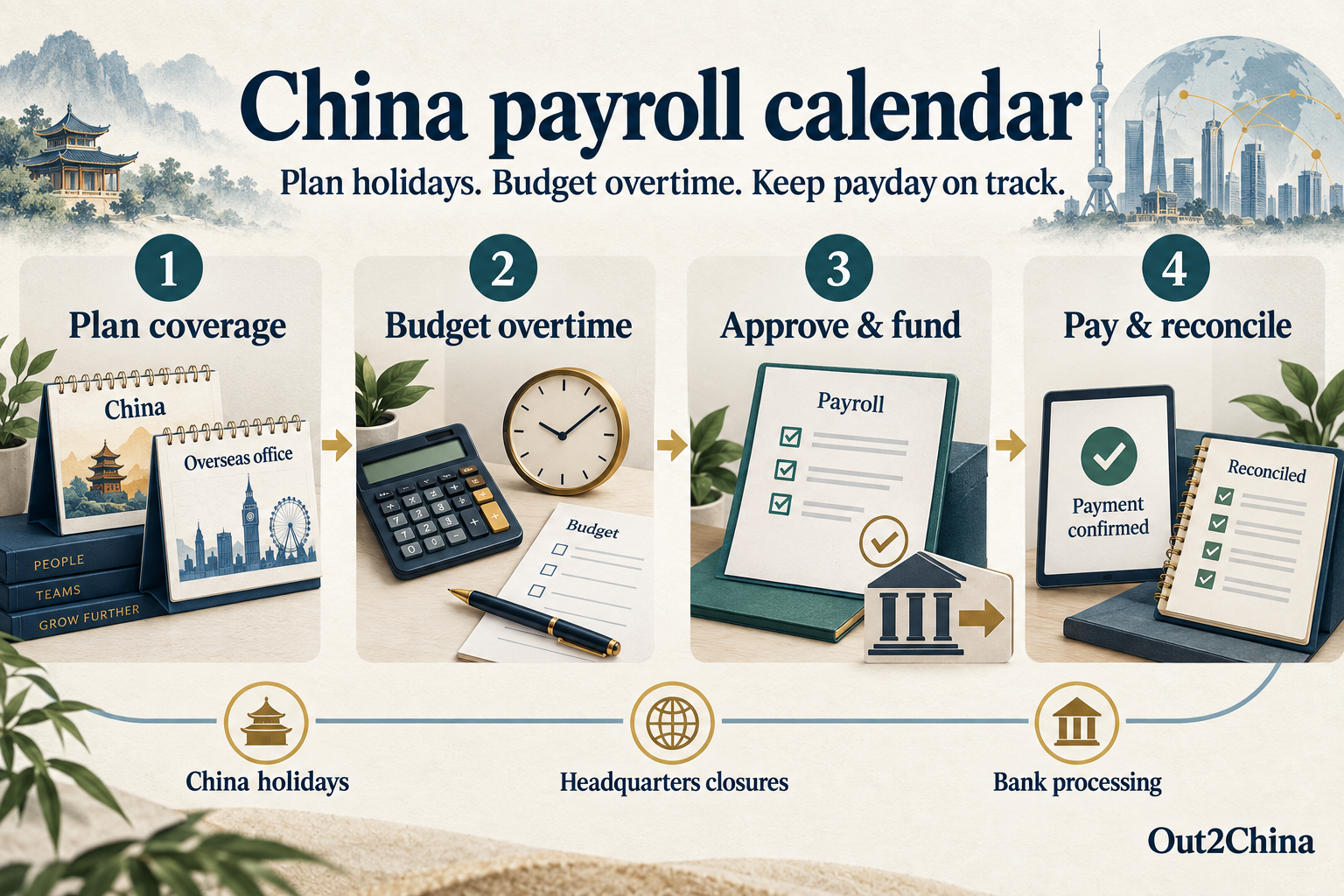
A payroll run between Mid-Autumn Festival and National Day
Build your China payroll calendar around payday
China payroll cut-off dates: work backwards from payday
Planning point Work to finish Evidence needed Around T minus 10 processing days Collect joiners, leavers, salary changes, attendance, overtime and bonuses Complete input file with the period covered Around T minus 8 Resolve missing inputs and check holiday classifications Exception list and manager confirmations Around T minus 6 Calculate draft payroll and explain changes from the prior run Payroll register and variance report Around T minus 5 Obtain approval for the identified payroll version Named approver, timestamp and version Around T minus 3 Confirm sufficient cleared funds and the payment route Funding confirmation and bank cut-off T, followed by reconciliation Pay employees, investigate rejected payments and close the run Payment status matched to the approved register China public holidays: separate holiday dates from the full break
Four major holiday periods to check in your payroll calendar
Holiday Full break in 2026 Statutory holiday dates Make-up working days Spring Festival / Chinese New Year February 15 to 23 February 16 to 19 February 14 and 28 Labour Day / May Day May 1 to 5 May 1 and 2 May 9 Mid-Autumn Festival September 25 to 27 September 25 None for this break National Day October 1 to 7 October 1 to 3 September 20 and October 10 Spring Festival in your China payroll calendar
Labour Day in your China payroll calendar
Coordinate your China payroll calendar with headquarters and banks
Period Question for the international team Decision to record before the break Spring Festival / Chinese New Year Which customer work cannot wait, and who will be away beyond the official break? Agreed coverage, handover files, leave plans and payroll approval backup Labour Day / May Day Does month-end payroll coincide with unavailable approvers? Payment confirmation, May coverage forecast and rejected-payment contact Mid-Autumn Festival Can deadlines move so employees do not have to interrupt family plans? Deliverables completed early and a narrow list of genuinely urgent work National Day / Golden Week Which overseas commitments continue during the China break? Necessary shifts, date-by-date cost estimate and a customer communication plan Christmas / overseas year-end closure Who can answer China employees and authorise payroll when headquarters is closed? Delegated authority, approved work plan, cleared funding and an available contact When China is on holiday but headquarters is working
Christmas holidays in China: who approves payroll when headquarters closes?
Can China employees follow headquarters' holiday calendar?
Business need Arrangement to consider Check before confirming Overseas operations need support on a Chinese statutory holiday Discuss necessary coverage, pay statutory overtime and optionally provide additional leave Christmas leave cannot replace the statutory-holiday overtime payment Work is needed on an ordinary rest day Arrange qualifying compensatory rest, or pay at least 200% where it cannot be arranged Record the rest arrangement and when it's actually taken Headquarters closes for Christmas and the China office may also close Offer additional paid company leave, or arrange paid annual leave in accordance with the rules Check eligibility, remaining entitlement and employee preferences; communicate and record the arrangement Some roles must continue working Keep role-specific coverage and nominate authorised backup approvers Do not assume either that everyone is off or that everyone remains on call Can annual leave cover an overseas office closure?
Does a higher salary or allowance solve the problem?
Put the chosen arrangements into the payroll calendar
China payroll calendar costs: budget overtime by day type
Payroll budget example with an assumed wage base
Turn the overtime example into a team budget
Budget line Calculation Forecast amount Statutory-holiday overtime 3 employees × 8 hours × RMB 50 × 300% RMB 3,600 Rest-day overtime without compensatory rest 3 employees × 8 hours × RMB 50 × 200% RMB 2,400 Additional overtime wages Sum of the two lines RMB 6,000 Confirm holiday work before payroll approval
China payroll calendar approvals and backup contacts
Role Decision or record required China manager Confirm attendance, work arrangements and employee changes; nominate a holiday backup HR Check employment records, applicable pay arrangements and completeness of inputs Payroll team or provider Calculate the run, identify exceptions and explain material variances within the agreed scope Authorised approver Approve the specific payroll version and resolve escalated business decisions Finance and payment operator Arrange funds, release the approved payment and monitor the bank result What if the holiday hours arrive after cut-off?
Set up your first China payroll calendar
Close the monthly China payroll calendar
China payroll calendar template: a monthly checklist
Calendar field What to enter Payroll period and employee pay date The agreed date, any required adjustment, and the period being paid China holiday and workday classification Statutory holiday, rest day or designated working day; relevant roster Overseas closure and bank availability Actual headquarters/customer closures and confirmed payment processing Coverage and handover Necessary work, responsible manager and pre-holiday deliverables Overtime forecast Estimated hours and cost by day type, distinct from approved actual payroll Input and approval cut-offs Exact date, time zone, authorised approver and backup Funding and payment Cleared-funds deadline, release authority and payment-result check Exceptions and close Actual-hours reconciliation, corrections, responsible person and due date Final payroll calendar checks before payment
Who should use a China payroll calendar?
Frequently asked questions
Is there a single national salary payment date?
Can we pay after the holiday if our agreed pay date falls during it?
Can we replace statutory-holiday overtime pay with time off?
Does the 300% amount already include ordinary monthly pay?
What if overtime is confirmed after payroll cut-off?
Is Christmas a public holiday for our China employees?
Review your China payroll calendar
Last Updated: 15 October 2026 | Reviewed by Out2China Quick Answer Foreign employers can support employee retention in C...
Last updated: October 17, 2026 | Reviewed by Out2China Quick Answer A China hiring agency can help an overseas company r...