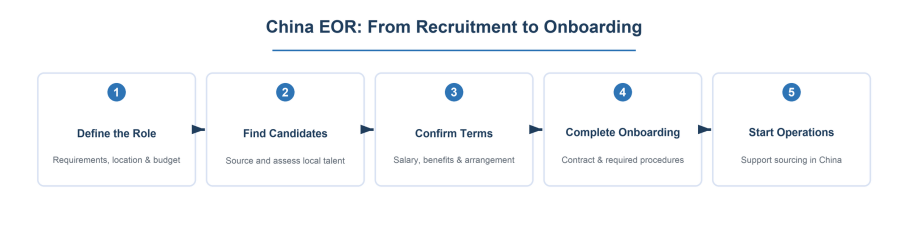
Last Updated: November 20, 2026 Australian importers can build a local sourcing team in China without setting up their own entity by using suitable recruitment and local employment solutions. Common hiring needs include Purchasing Officers and Quality Control Staff. Cities such as Shenzhen, Dongguan, Guangzhou, Suzhou and Ningbo offer different manufacturing and supply chain advantages. For companies without a Chinese entity, China EOR (Employer of Record) solutions can provide a way to arrange local employment, subject to the applicable legal and service requirements. China is an important sourcing market for Australian importers. However, managing suppliers from overseas can create practical challenges. A local sourcing team gives Australian companies a closer connection to their suppliers and day-to-day operations in China. The best hiring location depends on the products you source and where your suppliers operate. The following cities are worth considering. These cities have established industrial bases, but official statistics do not provide a directly comparable count of available Purchasing Officer or Quality Control candidates in each location. Therefore, this table compares industry relevance rather than ranking cities by candidate numbers. The charts below compare advertised pay for the two roles across three cities and three experience levels, based on live job ads on Liepin, a major Chinese recruitment platform, captured on 20 November 2026. Each bar shows the pre-tax monthly salary range in that market. If the role requires working English — for example, emails, calls or meetings with overseas clients or suppliers — budget roughly 15% to 35% above these figures (up to around 50% for some senior roles). Figure 1. Purchasing Officer: advertised pre-tax monthly salary range by experience level and city. Source: Liepin, 20 November 2026. Figure 2. Quality Control Staff: advertised pre-tax monthly salary range by experience level and city. Source: Liepin, 20 November 2026. A foreign company cannot simply assume its entity abroad can employ staff working in China. The employment contract, local payroll and statutory contributions all need to be handled in China. Setting up a Chinese entity for a small sourcing team is not always the first choice; a China EOR (Employer of Record) can provide the local employment structure instead. Figure 3. China EOR: the five steps from recruitment to onboarding. Under an EOR arrangement, a local service provider acts as the legal employer and handles contracts, payroll, social insurance and housing provident fund, while your company directs the employee's day-to-day work. EOR does not remove the need to comply with Chinese employment law, so the structure and responsibilities should be confirmed before hiring. From recruitment to onboarding, the process is straightforward: This lets a business build a local team without first setting up its own Chinese entity, where the arrangement is legally and operationally suitable. Budget for more than the salary: employer statutory contributions, the EOR service fee and other role-related costs should all be included. EOR is most useful for importers who source from China regularly without a local entity, need purchasing or quality control support, and want to start small before deciding whether to set up their own company. Out2China helps international employers recruit talent in China and arrange local employment without setting up their own entity. We can help you define the role, source candidates in the right city and handle contracts, payroll and other employment administration. Planning to build your China sourcing team? Contact Out2China to discuss your hiring needs. Website: https://out2china.com/ Yes, it may be possible through a suitable local employment arrangement, such as a China EOR solution. The structure must comply with applicable Chinese laws and regulations. Shenzhen, Dongguan, Guangzhou, Suzhou and Ningbo are worth considering because of their manufacturing and supply chain industries. The best location depends on your products and supplier network. It depends heavily on city and experience. Recent job postings show advertised monthly ranges from around RMB 6,000–9,000 for junior roles up to RMB 15,000–25,000 for senior roles. Roles requiring English carry a premium of roughly 15%–35%. See section 2.2. Pay depends on the product category, technical requirements, experience and city. Recent job postings show advertised monthly ranges from around RMB 6,000–10,000 for junior roles up to RMB 15,000–25,000 for senior roles, with an English premium of around 15%–35%. A China EOR provider can act as the local employer under a suitable arrangement and handle agreed employment administration, such as contracts, payroll and social insurance. This may be possible, depending on the provider's service scope, employment structure and applicable legal requirements.
快速了解
Key Takeaways
1. Why Do Australian Importers Need a China Sourcing Team?
2. Where to Hire Purchasing Officers and Quality Control Staff in China
2.1 Which Cities Have Relevant Industry and Talent Resources?
城市 Relevant Industry Base Hiring Considerations 深圳 Electronics, communications equipment and advanced manufacturing Suitable for electronics sourcing and related quality control roles 东莞 Electronics, smart devices, components and general manufacturing Relevant for consumer products, components and factory sourcing 广州 Automotive, electronics, machinery and consumer goods Offers access to a broad range of manufacturing and trading businesses 苏州 Electronics, equipment manufacturing and advanced materials Worth considering for industrial products, machinery and components 宁波 Manufacturing, international trade and port-related supply chains Relevant for export-oriented purchasing and supplier coordination 2.2 What Salary Budget Should Employers Expect?
Purchasing Officer

Quality Control Staff
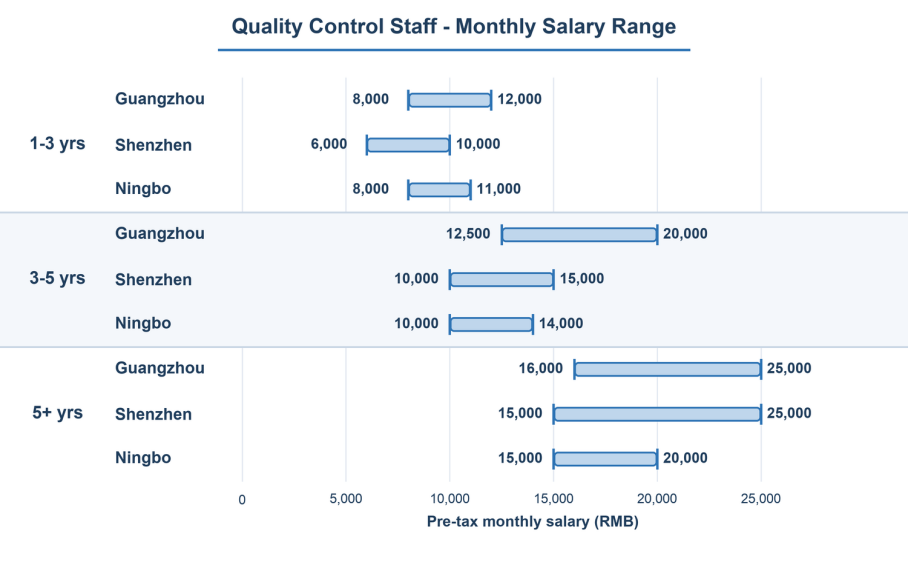
Notes on the data:
3. How to Hire in China Without a Local Entity
4. How Out2China Can Help
5. Frequently Asked Questions
Can an Australian company hire employees in China without a local entity? Which Chinese cities are suitable for hiring Purchasing Officers? How much does a Purchasing Officer earn in China? How much does Quality Control Staff earn in China? How does China EOR work for Australian companies? Can I hire both Purchasing Officers and Quality Control Staff through a China EOR? Data Sources