
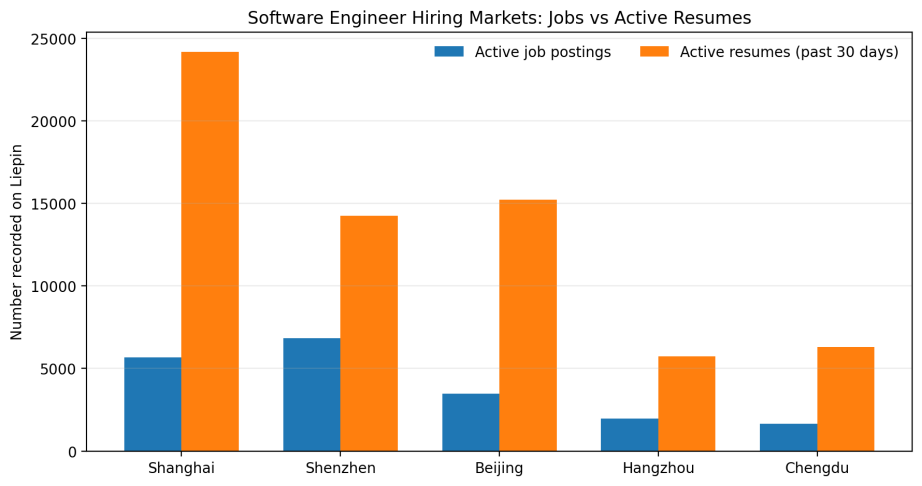
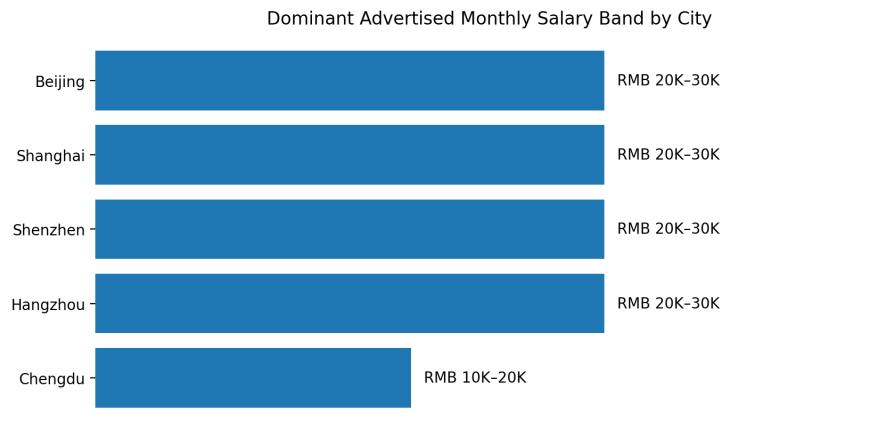
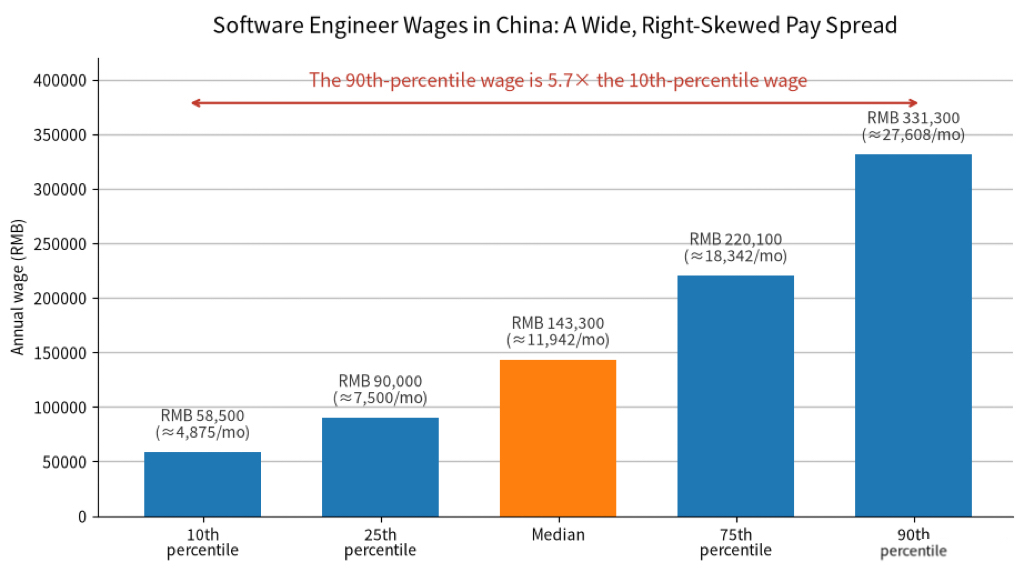
Hiring software engineers in China can give overseas companies access to a broad technical talent market. But finding the right person involves more than choosing a city and setting a salary. Different locations have different industry profiles, compensation levels, and pools of candidates with relevant experience. This guide explains how to approach these decisions using official Chinese market data and practical recruitment considerations. China's software industry is geographically concentrated, but there is no single best city for every engineering role. Your ideal location depends on the product you are building, the technical skills you need, and the salary budget you can offer. The Ministry of Industry and Information Technology reported that China's software industry generated RMB 15.48 trillion in revenue in 2025, up 13.2% year on year. Beijing, Guangdong, Jiangsu, Shandong, and Shanghai ranked among the five largest regions by software business revenue. Software revenue in the Yangtze River Delta and Beijing–Tianjin–Hebei regions grew by 15.2% and 14.9%, respectively. Source: Ministry of Industry and Information Technology — China's Software Industry Performance in 2025. These figures indicate where substantial software industry activity is taking place. They do not directly measure the number of available software engineers or prove that one city is easier to recruit in than another. Nevertheless, they provide a useful starting point for deciding which markets to investigate. A snapshot of Liepin's job and resume databases provides a more direct view of software engineer recruitment activity. The search covered jobs with the title “software engineer” and active resumes across five major Chinese cities. It identified approximately 19,619 active job postings across Beijing, Shanghai, Shenzhen, Hangzhou, and Chengdu, representing around 48.3% of the national total recorded in the dataset. Source: Liepin platform job database and resume database, snapshot at the time of the query. Figures are platform data, not official government statistics. Shanghai had the largest pool of resumes active within the previous 30 days, while Shenzhen had the highest number of active job postings among these five cities. This makes both markets worth investigating, but for different reasons. Shanghai's larger active resume pool may give employers more profiles to screen; Shenzhen's higher posting volume means employers should pay close attention to competing opportunities and candidate expectations. These figures do not prove that Shanghai is always faster to hire in or that Shenzhen is always more difficult. Job postings are not the same as approved headcount, and active resumes do not necessarily represent qualified candidates who are ready to change jobs. The data is best used as a starting point for deciding which markets to investigate and which assumptions to test during recruitment. Beijing is worth investigating when you need engineers working on artificial intelligence, algorithms, research-intensive products, or other advanced technical systems. The Beijing Municipal Human Resources and Social Security Bureau reported that, in its second-quarter 2025 salary survey, median monthly salaries for AI large-model architects, deep-learning researchers, and natural language processing engineers each exceeded RMB 42,000. Source: Beijing Municipal Human Resources and Social Security Bureau — 2025 Q2 Salary Report. These figures relate to specialist, high-end positions, not ordinary software development roles. An overseas company hiring a general backend engineer should not use them as its default salary benchmark. Recruitment consideration: If your role requires specialist AI knowledge or research experience, investigate whether the relevant skills are available within your budget before committing to a narrow location or an overly restrictive job description. Shanghai is another market worth considering for software development and technical roles supporting business applications, digital products, and international operations. The city's software industry is part of the wider Yangtze River Delta software economy, which recorded 15.2% year-on-year revenue growth in 2025, according to the Ministry of Industry and Information Technology. This regional figure is useful context, but it is not a Shanghai-specific software engineer salary or talent-count statistic. Employers should therefore validate the actual candidate pool for their target role rather than assuming that the size of the regional software industry guarantees an easy search. Recruitment consideration: If your team needs engineers who can work across product, business, and technical functions, specify the expected responsibilities and communication requirements. These details can materially change which candidates are suitable. Shenzhen is worth investigating for roles related to embedded software, communications, connected devices, and software development closely linked to physical products. Local wage data offers a more specific reference point here. Shenzhen's Human Resources and Social Security Bureau published its 2025 human resources market wage data in April 2026. The report provides occupational wage figures that employers can use when assessing local compensation expectations. Source: Shenzhen Human Resources and Social Security Bureau — 2025 Market Wage Data. The report distinguishes between occupational categories, so the figures for software engineering technicians and computer programmers should not be treated as interchangeable. When using local wage data, match the category as closely as possible to the actual job. Recruitment consideration: If your role requires both software skills and experience with a particular product, device, or technical environment, search for those requirements explicitly. A general software engineer search may return many candidates who do not have the relevant background. Hangzhou and Chengdu may also be worth including in a recruitment search, depending on the role, the company's working arrangements, and the candidates available. However, employers should avoid assuming that a city automatically offers lower salaries, a larger talent pool, or an easier recruitment process. Those conclusions require role-specific evidence. If your search in one city produces too few suitable candidates, expanding the search to another location can be a reasonable next step. Whether this is worthwhile depends on how many additional candidates become available, whether they meet the technical requirements, and whether the company can accommodate the relevant working arrangements. The best location is therefore not necessarily the city with the lowest salary benchmark. It is the market in which your company can realistically find the required skills within its budget and timeframe. Liepin's advertised salary data shows a different pattern in Chengdu. Its dominant advertised monthly salary band was RMB 10,000–20,000, while the other four cities had a dominant band of RMB 20,000–30,000. This makes Chengdu a market worth exploring when budget is an important consideration. Dominant advertised monthly salary band by city. Bar lengths are illustrative, not quantitative. Source: Liepin platform snapshot. However, a lower dominant salary band does not automatically mean a lower total recruitment cost or an easier search. The result may change significantly for senior engineers, specialist technology stacks, or roles requiring strong English communication. Hangzhou may also be worth including in a wider search when the initial target market does not produce enough suitable candidates. For employers, the practical question is not simply which city has the lowest advertised salary. It is whether the target city has enough candidates who match the actual role at a salary the company can afford. Salary benchmarking should start with official data, but the figures need to be interpreted carefully. The Ministry of Human Resources and Social Security's 2025 Enterprise Wage Survey reported the following annual wage figures for computer software engineering technicians nationwide: Annual wage distribution for computer software engineering technicians by percentile, national data. Bars show the annual wage with the monthly equivalent (annual ÷ 12) in parentheses; the median is highlighted. Source: Ministry of Human Resources and Social Security — 2025 Enterprise Wage Survey.l These are national occupational wage benchmarks, not guaranteed salaries for a particular vacancy. The monthly figures are annual amounts divided by 12 for comparison; they are not separately reported monthly salaries. The survey's wage measure includes basic pay, bonuses, allowances, overtime pay, and other wage income as defined in the official methodology. Use these figures to establish an initial range, then adjust it according to the position you intend to fill. A junior developer working on defined tasks, a senior engineer responsible for architecture, and a specialist with experience in AI infrastructure may have very different compensation expectations. Industry knowledge, technical complexity, English communication requirements, and the degree of independent ownership can also affect the appropriate budget. Liepin's snapshot provides a useful second reference point: advertised monthly salary bands for software engineer vacancies. In all five cities, RMB 20,000–30,000 was the dominant band except in Chengdu, where RMB 10,000–20,000 was dominant. The report also shows a consistent relationship between seniority and advertised salary bands across the five cities: These bands can help employers form an initial budget, but they should not be treated as precise salary averages or guaranteed offer levels. Liepin's methodology allows one advertised salary range to overlap multiple salary bands, so exact means and medians cannot be calculated from these counts. The data also does not establish whether annual bonuses are included in every advertised package. For a senior role, setting a budget based only on the national median may therefore be misleading. The more useful comparison is between the proposed salary, the required experience, and the advertised ranges for similar positions in the target city. A national median can help you understand the wider market, but it cannot tell you exactly what to offer in Beijing, Shanghai, or Shenzhen. Where comparable local government data is available, use it to refine the estimate. Check the year of the survey, the occupation being measured, the wage definition, and whether the data represents actual employee wages or salaries advertised for open positions. Do not compare figures from different reports as if they were collected using identical methods. For example, a local market recruitment salary may represent advertised hiring pay, while an annual enterprise wage survey may measure compensation received by employees. Differences between these figures do not necessarily indicate a change in market salaries. Your final budget should also account for the employment arrangement and employer-side costs, rather than treating gross salary as the entire cost of hiring. Salary data and industry statistics help you understand the market, but they cannot fully predict how difficult a particular vacancy will be to fill. Two jobs with the same title can have very different recruitment outcomes. A general backend developer role may attract candidates from a broad range of companies. A position requiring a specific technology stack, experience in a niche industry, strong English communication, and independent technical decision-making will usually need a more targeted search. Before recruitment begins, clarify four things: Distinguish essential requirements from preferences. If every item in a long job description is treated as mandatory, the search may become unnecessarily restrictive. It is also important to validate your assumptions against the actual candidate market. Published statistics cannot tell you how many candidates meet your full set of requirements, how many are open to a move, or how they will respond to your proposed salary. A practical recruitment process should generate feedback as the search progresses. For example, if the initial search produces few suitable candidates, a local recruitment partner can help assess whether the issue is the salary range, the target location, the required skills, or the combination of requirements. The next step depends on what the search reveals: These are not automatic reasons to increase the budget or change cities. They are decisions that should be informed by evidence from the search. This is where local recruitment support becomes particularly useful: it connects published market benchmarks with the responses and qualifications of actual candidates. For overseas employers, choosing a city and setting a salary are only the beginning. The challenge is turning those assumptions into a realistic recruitment plan and finding candidates who meet the business requirements. Out2China helps overseas employers recruit talent in China. Depending on the role, recruitment support can include clarifying the job requirements, identifying relevant candidates, assessing their fit, and providing feedback on the local market throughout the search. That feedback can help you understand whether your proposed salary appears competitive, how readily suitable candidates are being found, and whether the role specification or search location needs to be adjusted. Rather than relying solely on a national salary average or making a decision based on a city's reputation, employers can use this information to refine their approach as recruitment progresses. If you are planning to hire a software engineer in China, start with the job itself: the skills you need, the level of experience required, and the budget available. From there, the right recruitment strategy can be developed around the actual market for that role. Need help hiring software engineers in China? Contact Out2China to discuss your requirements and explore a recruitment approach based on your role, budget, and target candidate profile. Learn more about our China hiring agency services or read our China salary guide for broader compensation context. There is no single best city for every software engineering role. The right choice depends on the technical skills, industry experience, salary budget, and working arrangements required. Start with relevant software industry centres, then validate the candidate pool for your specific vacancy. The Ministry of Human Resources and Social Security reported a median annual wage of RMB 143,300 for computer software engineering technicians in its 2025 Enterprise Wage Survey. This is a national occupational benchmark, not a guaranteed salary for a particular role or city. Yes, local wage levels can differ. Employers should consult relevant city-level government wage reports where available and check that the occupation and survey methodology match the role they intend to recruit. Use official wage data as a starting point, then compare your offer with the requirements and seniority of the role. Recruitment feedback can help establish whether suitable candidates are responding to the proposed salary and whether the budget needs to be reviewed. First, review the search results to understand the main constraint. You may need to broaden the geographic search, adjust non-essential requirements, or reconsider the salary and seniority level. A local recruitment partner can help evaluate these options using feedback from the candidate market. Out2China supports overseas employers with recruitment in China. Employers should also confirm the appropriate local employment arrangement before making an offer. Official salary statistics and industry revenue figures provide useful market context, but they do not directly measure the number of candidates available for a specific vacancy. Candidate availability, salary competitiveness, and recruitment difficulty should be assessed against the actual requirements of each role. Liepin figures in this article are a snapshot of the platform's job and resume databases at the time of the query. They are not official national statistics or a complete count of China's software engineering workforce. Advertised salary bands overlap when a job's salary range spans multiple bands, so the figures do not establish exact average or median advertised salaries. The data should be used as a directional reference and validated against the requirements of each vacancy.
By Out2China
|
Published on
快速了解
1. Where Should You Hire Software Engineers in China?
What does recruitment platform data show?
Beijing: Consider It for AI and Advanced Technical Roles
Shanghai: Evaluate It for Product and Enterprise Engineering Needs
Shenzhen: Consider It for Product Development and Hardware-Connected Engineering
Hangzhou and Chengdu: Keep the Search Open When Appropriate
When might Hangzhou or Chengdu be worth considering?
2. How Much Should You Budget for a Software Engineer in China?
What salary ranges are advertised in different cities?
Why City-Level Salary Data Matters
3. How Difficult Will It Be to Find the Right Candidate?
Use Recruitment Feedback to Test Your Hiring Plan
4. How Out2China Can Help You Recruit Software Engineers in China
常见问题
1. Which city in China is best for hiring software engineers? 2. What is the average salary of a software engineer in China? 3. Are software engineer salaries different across Chinese cities? 4. How can I tell whether my salary budget is competitive? 5. What if I cannot find suitable software engineers in my target city? 6. Can Out2China help overseas companies recruit software engineers in China? Data note
Additional data note
Last Updated: 15 October 2026 | Reviewed by Out2China Quick Answer Foreign employers can support employee retention in C...