
Last Updated: November 20, 2026 Quick Answer Australian importers can build a local sourcing team in China without setti...
A foreign employee needs a China work permit and a work-type residence permit before starting work in mainland China, and only an employer in China can apply. A foreign company with no China entity can hire through an employer of record (EOR), whose Chinese company signs the labour contract and applies if the candidate, role, salary and city qualify. Any foreign national who will be employed and paid for work in mainland China generally needs a work permit and a work-type residence permit, unless a specific statutory exception applies. A tourist or business visa, or visa-free entry, does not allow the holder to work in China. The work permit is always tied to an employer in China. The company that signs the labour contract is the one that applies, through the foreigners' work management system on the national human resources and social security service platform (12333.gov.cn). That is why a foreign company without a Chinese entity cannot sponsor a work permit on its own. Only Z and R visas lead to employment in China. Tourist and business visas, and visa-free entry, are for travel and meetings only. With an employer of record arrangement, a Chinese company with a lawful employment arrangement signs the labour contract with your employee, runs payroll and withholds individual income tax. Social insurance is handled under local rules; for foreign employees, housing fund contributions depend on the city's rules and, in some cities, on what the employer and employee agree. Your team still directs the day-to-day work. For a foreign employee, the employing company is also the party that applies for the work permit and supports the residence permit application. In our standard arrangement, our own licensed Chinese company is the contractual employer. Some assignments use a local partner; we identify the employer before onboarding. Two points to settle early: Most applicants use a Z (work) visa; category A high-end talent can apply for an R (talent) visa instead. Foreign workers in China are managed in three categories: Category A applicants can obtain a Confirmation Letter of High-end Foreign Talent and use it to apply for the R visa. Under the Implementing Measures for the Foreign Talent Visa System, an R visa can be valid for 5 to 10 years and allows multiple entries, and spouses and minor children can obtain multiple-entry visas with the same validity (State Council Gazette, in Chinese). The usual order is work permit notice, Z or R visa, entry and address registration, then the residence permit. 1. Work permit application and notice. The employing company submits the application online, with the employee's documents, to the local authority responsible for foreigners' work permits. If approved, the authority issues a Notification Letter of Foreigner's Work Permit. Category A applicants can also obtain a Confirmation Letter of High-end Foreign Talent, which is used for the R visa. 2. Z or R visa. With the notice or confirmation letter, the employee applies for the visa at a Chinese embassy or consulate, normally in their home country or country of residence. An R visa holder can enter China and complete the work permit and residence permit there. 3. Entry to China and address registration. The employee enters China and must register their address with the local police within 24 hours of arrival. If they stay in a hotel, registration is usually completed at check-in. 4. Residence permit. An employee who enters on a Z visa must apply for a work-type residence permit within 30 days of entry, as required by the Exit and Entry Administration Law. This is the deadline for applying, not a promise that the permit will be issued within 30 days. Since 1 December 2024, foreign employees no longer receive a physical work permit card: the work permit information is linked to their social security card, and they apply for the residence permit with the work permit notice or the electronic social security card carrying the permit information (MOHRSS notice, 人社部发〔2024〕75号). The work permit itself is still required. The employee can start work only after work authorisation and the residence permit are in place. Yes for meetings, no for work. While the work permit is processed, the employee can enter China on a business (M) visa, or visa-free where their nationality qualifies, to meet the team or attend meetings. They cannot start working in China, and the Chinese employing company cannot pay them, until work authorisation and the residence permit are in place. This is one of the first questions clients ask us. A business visa cannot be converted into a Z visa inside China. On the standard route, the Z visa is issued by a Chinese embassy or consulate outside mainland China after the work permit notice, so the employee will usually need to leave mainland China to collect it, often in their home country. Depending on nationality and residence, some applicants can apply elsewhere; check with the issuing office before travelling. Shanghai has published one answer on an in-country route. Replying to a specific enquiry, Shanghai's exit-entry authority said that an employee who entered on an M visa could first apply for a work permit after entry, and then apply for a work-type residence permit in Shanghai (Shanghai exit-entry answer). This is an answer to one enquiry, not a general rule, and it should not be read as applying to other cities: in-country applications must meet the work permit conditions, both permits need approval, and the employee cannot work until both are granted. Confirm with the local authorities before relying on it. A recent enquiry raised exactly this question. An overseas retail group with no entity in China planned to send an employee to Shanghai on a tourist visa and process the work permit in parallel. Our advice was not to use the tourist visa, and we set out two options for the client to consider: the standard Z visa route, or, if the authorities would accept this route for the employee's circumstances, entry on an M visa with every document prepared in advance, so that the work permit application could be filed on arrival and the work-type residence permit applied for once the work permit was granted. Under either option, the employee could start work only after both permits were approved. Plan the start date around the route you choose. For senior foreign hires, employer conditions and local incentives can differ sharply between cities, so compare cities before you apply. An overseas company with no entity in China wanted to move a senior foreign manager to mainland China. The plan started in Guangzhou. The employee also hoped to apply for the Greater Bay Area individual income tax subsidy, which can reduce the tax burden for eligible overseas high-end and shortage talent working in the nine Guangdong cities of the Greater Bay Area. When we checked the local rules, the two cities set very different conditions. In Guangzhou, the high-end talent route required the employer to meet scale and enterprise-type thresholds that a newly set-up branch could not meet. In Shenzhen, the conditions for an employer in the human resources services sector were broader, and we confirmed this with the district human resources bureau. The plan we proposed: In the proposal, we listed what we could commit to separately from what depended on the authorities. We do not take on hires set up mainly to obtain a work visa, because a China work permit is approved for a specific job. Every so often someone asks whether they can set up their own company overseas, sign an EOR contract with us, and be paid the minimum wage in China, mainly so that they can obtain a work visa. We have declined these enquiries, and a similar one from a company that wanted a work permit at the minimum wage before the role and salary were even settled. The authorities look at whether the role is genuine, whether the salary fits the role and the city, and whether the employee's degree and experience match it. An arrangement set up mainly to obtain a visa is unlikely to meet that test, and it can expose both the employee and the employing company to legal risk. For this reason, we only assess and quote a case once the employer, the role and the salary are settled. The degree certificate and the criminal record check, both authenticated for use in China, usually take the longest, so start them first. Requirements vary by city and category, but most applications ask for: How to prepare them: Nobody can guarantee approval, but applications go more smoothly when the role is genuine and clearly described; the degree and experience match the role; the salary fits the role and the city (a salary well below the local market for the position weakens the application); the employing company is the real employer; and the documents are complete and consistent before submission. In our experience, once all documents are complete, the work permit and visa stage typically takes around 1.5 to 2 months. This is an estimate, not a guaranteed timeline: the city, the permit category and the authorities' workload all affect it. Before that stage, obtaining and authenticating the degree and the criminal record check in the employee's home country can take several weeks, depending on the country. An employee who enters on a Z visa must then apply for the residence permit within 30 days of entry. Plan around Chinese New Year. The official 2027 Spring Festival holiday runs from 5 to 13 February (State Council General Office notice, in Chinese). Government offices slow down before and after the break, so a December or January start date needs extra time. The most serious mistake is starting work on a business visa before work authorisation and the residence permit are in place. Government fees, medical checks, authentication and translation are charged at cost. Our fees for work permit support are quoted separately, based on the case. To estimate salary and employer contributions, use our China social insurance and housing fund calculator. If you expect to build a larger team later, see EOR vs WFOE in China. To discuss a specific hire, talk to us. A foreign company without a China entity cannot apply directly, because the work permit must be sponsored by an employer in China. An EOR's Chinese employing company may be able to sponsor the employee instead. Whether it can depends on the candidate, the role, the salary, the city and the proposed arrangement. A China work permit is not a Z visa. The employer in China applies for the work permit, which allows work in China. A Chinese embassy or consulate issues the Z visa, an entry visa, after the work permit notice. Category A talent using an R visa follows a separate process. After entry, a work-type residence permit is still needed. Since 1 December 2024, foreign employees no longer receive a physical work permit card. The work permit information is linked to their social security card, and they apply for the residence permit with the work permit notice or the electronic social security card. The work permit itself is still required. A foreign employee cannot work in China on a business visa. On a business (M) visa, or on visa-free entry, the employee can attend meetings, visit partners and meet the team, but cannot work in China or be paid by the Chinese employing company. Work can start only after work authorisation and the work-type residence permit are in place. In Shanghai, the exit-entry authority has said, in answer to one enquiry, that an employee on a business (M) visa can apply for a work permit after entry and then for a work-type residence permit. This is not a general rule: each case is assessed separately, both permits need approval, and work cannot start until both are granted. A candidate coming to China for interviews can generally use a business (M) visa, or visa-free entry where their nationality qualifies. Interviewing and meeting the team are not employment. If the candidate is hired, the employer applies for the work permit and the candidate later obtains a Z or R visa. A foreign employee who lives in China and is paid for work done here should, to be safe, get a work permit. A tourist or business visa, or visa-free entry, does not allow work in China, even for an overseas employer. An EOR may be able to act as the employing company, depending on the candidate, role and city. Someone on a tourist visa generally cannot switch to a work visa inside China. The Z visa is applied for outside mainland China after the work permit notice is issued, usually from the home country or country of residence. In-China exceptions include category A talent, R visa holders, and foreigners already working in China who change employer. An R visa makes sense when the employee qualifies as category A high-end talent, for example through the points assessment. Issued on the basis of a confirmation letter, it can be valid for 5 to 10 years, with multiple entries. Spouses and minor children can obtain visas with the same validity. In our experience, the China work permit and visa stage typically takes around 1.5 to 2 months once documents are complete. Authenticating the degree and criminal record check at home adds several weeks. After entry on a Z visa, the employee must apply for the residence permit within 30 days. Timings vary by city and category and are not guaranteed. Using an EOR does not guarantee that the work permit will be approved. Approval depends on the authorities' assessment of the applicant, the role and the documents. An EOR can help assess eligibility and coordinate the application, but cannot guarantee the outcome. The proposal should state who is responsible for each step and which documents are needed. A foreign employee's salary under a Chinese labour contract is agreed and paid in RMB. Under an EOR arrangement, the client can fund payroll in another currency, such as US dollars or Australian dollars; the EOR settles the invoice and pays the salary in RMB. Some clients keep part of the salary paid abroad, for example to maintain the employee's residency elsewhere, and pay the rest through the China payroll. Chinese individual income tax generally depends on where the work is performed and how long the employee stays in China, not only on where the money is paid. Consult a tax adviser before deciding. A foreign employee can usually bring their family. The spouse and children can generally apply for dependant visas and residence permits linked to the employee's permit. For R visa holders, spouses and minor children can obtain visas with the same validity as the employee's. Requirements and documents vary, so check with the local authority. When the employment ends, the employer cancels the work permit online in the foreigners' work management system, because the permit is tied to the employing company. The employee's residence permit must be changed or cancelled accordingly. The employee then needs sponsorship from a new employer in China or must leave within the period allowed. This article is general information, not legal, tax or immigration advice. Requirements and incentives change and differ by city. Confirm the current rules for your case before you act.
Quick Answer
Who needs a China work permit?
China visa types compared: tourist, business, work and talent
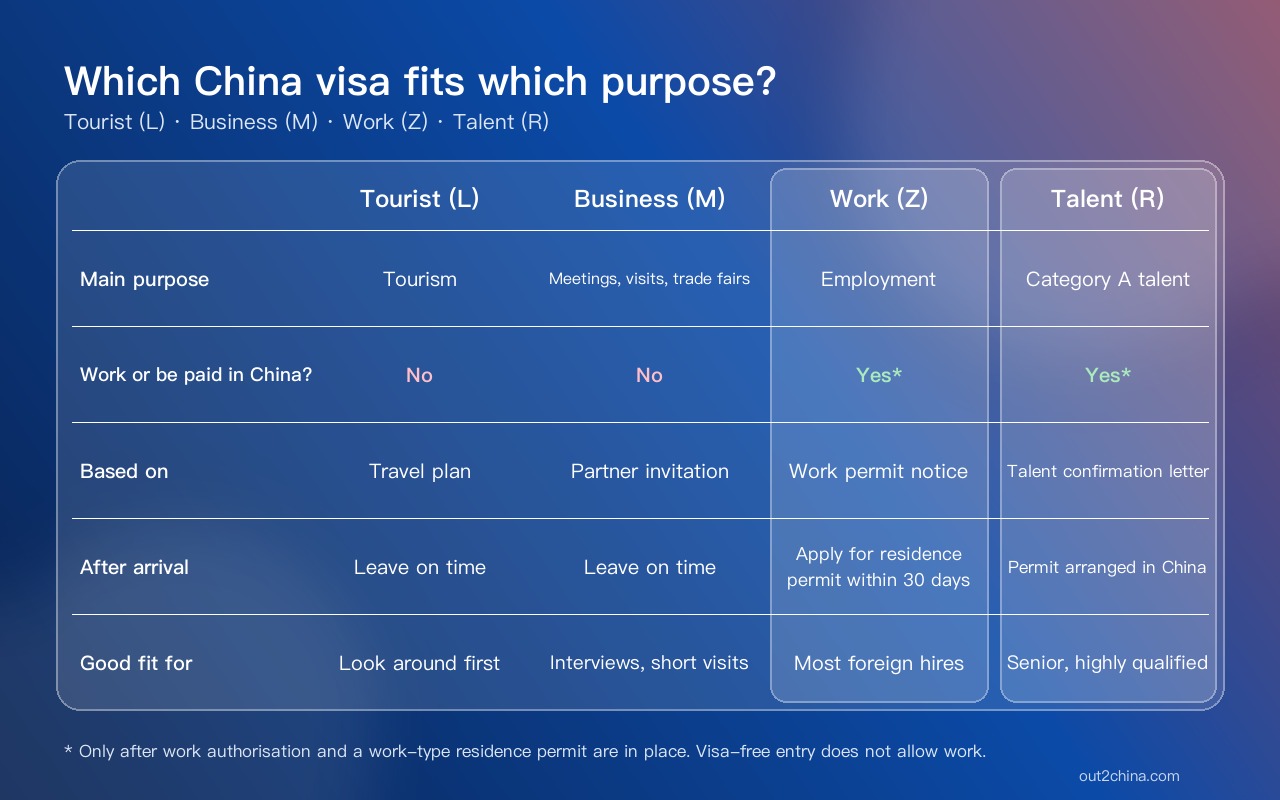
Tourist (L)
Business (M)
Work (Z)
Talent (R)
Main purpose
Tourism
Meetings, trade fairs, visiting partners and suppliers
Taking up employment in China
High-end foreign talent (category A)
Can the holder work or be paid in China?
No
No
Yes, once work authorisation and the residence permit are in place
Yes, once work authorisation and the residence permit are in place
What it is based on
Travel plan
Invitation from a Chinese business partner
Work permit notice from the employer in China
Confirmation Letter of High-end Foreign Talent
Who arranges it
The traveller
The traveller, with the partner's invitation
The employing company first, then the employee
The employing company first, then the employee
After arrival
Leave before the permitted stay ends
Leave before the permitted stay ends
Apply for a work-type residence permit within 30 days
Multiple-entry visa valid for 5 to 10 years; for long-term work, the work permit and a work-type residence permit are arranged in China
Good fit for
Holidays; looking around before a move
Meeting the team, interviews, signing contracts, short visits
Most foreign employees
Senior or highly qualified hires who meet category A
How an EOR fits in
China Z visa or R visa: category A, B and C
The four steps
Can a foreign employee come on a business visa while the work permit is processed?
Choosing the city: a case from our files
The cases we turn down
Documents and how to prepare them
How to improve the chance of approval
How long does it take?
Common pitfalls
Cost
FAQ
Can I get a China work permit without a company in China?
Is a China work permit the same as a Z visa?
Do foreign employees still get a work permit card?
Can a foreign employee work in China on a business visa?
Can an employee on a business visa apply for a work-type residence permit in Shanghai without leaving China?
Which visa should a candidate use to come for interviews?
Does a foreign employee working remotely for an overseas company from China need a work permit?
Can someone on a tourist visa switch to a work visa inside China?
When does an R visa make sense instead of a Z visa?
How long does it take to get a China work permit?
Does using an EOR guarantee the work permit will be approved?
What currency is a foreign employee's salary paid in?
Can part of the salary stay on the payroll in another country?
Can the employee bring their family?
What happens to the work permit when the employment ends?
Last Updated: November 20, 2026 Quick Answer Australian importers can build a local sourcing team in China without setti...
Learn how to hire procurement managers in China, compare salaries across cities and industries, and find the right locat...