Last Updated: 15 October 2026 | Reviewed by Out2China Quick Answer Foreign employers can support employee retention in C...
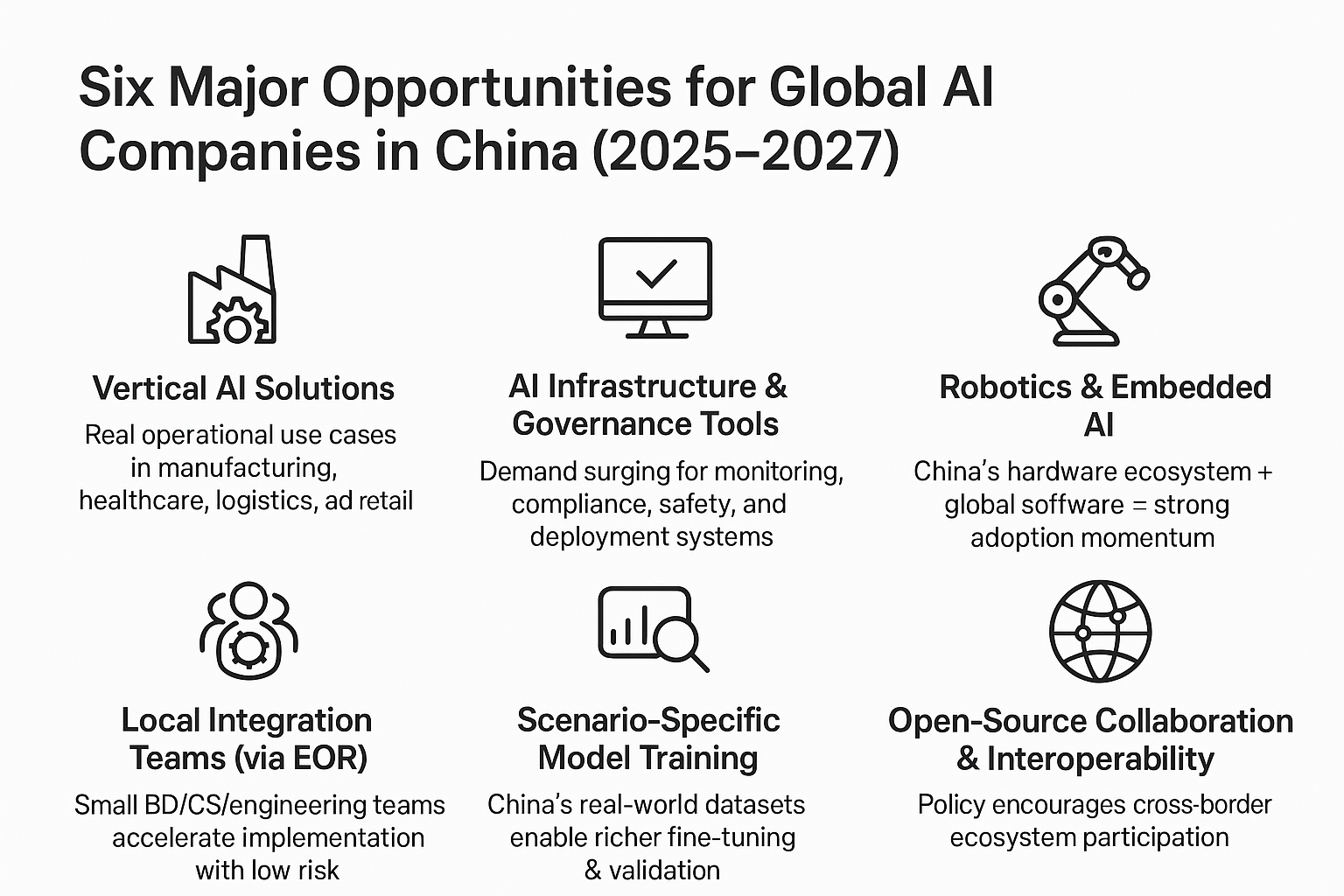
Updated: China has just released a major national policy — the “AI+ Action Plan” — aimed at accelerating large-scale AI adoption across every major industry. While the policy is written for domestic implementation, many of its developments directly translate into new opportunities for global companies, especially those in AI, SaaS, automation, robotics, and data-driven healthcare. In this newsletter, I break down the key points of the policy into a clear, business-focused guide — what matters, why it matters, and how international companies can participate in China’s fast-growing AI ecosystem. Let’s dive in. For years, China’s focus has been on building foundational AI capabilities — models, algorithms, data infrastructure, and compute clusters. The new AI+ Action Plan makes one thing clear: the country is now shifting from “building capability” to “deploying AI at scale.” AI is expected to deeply integrate into manufacturing, healthcare, transportation, logistics, education, finance, eldercare, disability services, and even government administration. The objective is no longer experimentation. It is a system-wide, scenario-driven implementation. For global companies, this shift is crucial. If your AI product solves a real operational problem — not just an LLM-based demo or hype — China’s industries are ready for adoption. The demand is large, urgent, and accelerating. One of the strongest signals in the policy is the emphasis on China’s massive and diverse data ecosystem. The country now generates over 41.06 ZB of data annually — 26% of global volume — spanning manufacturing lines, hospitals, logistics networks, retail behaviour, government services, and countless real-world scenarios. For AI/ML companies, this isn’t just a statistic. It translates into: Few markets offer this depth of complexity. Whether you are building industrial AI, multimodal models, robotics perception, workflow automation, or medical AI (non-regulated functions), China provides a rare environment where models can be tested, validated, and improved under real conditions. The AI+ policy outlines major investments across compute infrastructure, industry datasets, open testbeds, safety sandboxes, and open-source ecosystems. China has already released over 1,500 industry-grade models, spanning 700 real-world scenarios across more than 50 different sectors. This rapid ecosystem growth means China is becoming one of the world’s most efficient markets for taking an AI product from testing, to validation, to scale. If your product performs better in complex, high-density environments, China offers the testing ground that many Western markets simply cannot replicate at speed. Another major emphasis in the policy is talent development — something already visible on the ground. China now has the world’s largest STEM pipeline, nearly 10 million software developers, and a strong workforce of applied AI and industry-engineering talent. Deployment cycles in manufacturing, healthcare, logistics, and retail tend to be fast and practical. For international companies, this creates a strategic advantage: You can assess an EOR arrangement before setting up your own Chinese employing entity. Confirm the actual employer, role and work location first. The start date depends on candidate availability, offer acceptance, the notice period, required documents and first-month funding; agree those milestones before committing to a date. Based on the direction of the AI+ policy and current market behavior, several opportunity areas stand out clearly. First, China’s enterprises are actively looking for vertical AI solutions that solve real problems in manufacturing, healthcare, logistics, and retail. Hype is no longer enough — practicality wins. Second, there is rapidly growing demand for AI infrastructure and governance tools. Model monitoring, compliance, safety, observability, and deployment management are becoming essential. Third, China’s powerful hardware ecosystem makes it a strong market for robotics and embedded AI, especially when global companies bring advanced software or algorithms. Fourth, a small local support, integration, or engineering team can significantly accelerate adoption — and EOR hiring makes this fast and low-risk. Fifth, China’s vast reservoir of real-world data means international companies can benefit from scenario-specific model training and fine-tuning in partnership with Chinese enterprises. And finally, the policy explicitly encourages open-source collaboration and model interoperability, making it easier for international developers to participate in China’s ecosystem. Depending on your stage, there are three practical entry paths. 1. Sell into China from overseas 2. Assess local employment through EOR 3. Set up a WFOE once meaningful traction is achieved Out2China supports all three paths — from EOR hiring to full WFOE setup, payroll, tax, compliance, market development, and digital marketing. China’s AI ecosystem is evolving quickly — and the release of the AI+ Action Plan marks a shift from “preparing for AI” to “deploying it everywhere.” The country offers something rare: For international AI and tech companies, this is one of the most favourable windows in the past decade to explore China — whether through partnerships, hiring, localized deployment, or ecosystem collaboration. If you're considering the China opportunity—partnerships, hiring, regulatory strategy, business setup, or data access—feel free to get in touch. I’m happy to share tailored insights based on your industry and stage.1. The AI+ Action Plan
1.1. China Has Entered the Era of Large-Scale AI Application
1.2. Why China Is Becoming One of the World’s Best AI Training and Deployment Environments
1.3. Infrastructure Is Scaling Fast — Making China a Global Hub for Testing and Validation

1.4. A Deep and Cost-Competitive AI Talent Pool
you can build a China-based engineering, support, or integration team quickly and cost-effectively.2. Where the Opportunities Are for Global AI Companies (2025-2027)
3. How Global Companies Can Enter China — Without Heavy Upfront Investment
This is ideal for SaaS, AI platforms, dev tools, industrial AI, and robotics software.
With localized messaging, channel strategy, and early BD support, this is often the fastest way to test market demand.
For a sales, customer support or technical role, define the responsibilities, location and skills before sourcing. Ask the provider to name the employing entity and confirm the contract, payroll, contributions and HR support included in the proposed arrangement.
A local entity becomes useful when you need invoicing (fapiao), deeper partnerships, local contracting capability, or a team of 3–5+ employees.
This is often the step companies take after successfully validating the market.4. Why Now Is the Right Moment
scale + data + talent + infrastructure + policy alignment, all moving in the same direction.
Last Updated: 15 October 2026 | Reviewed by Out2China Quick Answer Foreign employers can support employee retention in C...
Quick answer A China payroll calendar should show when employees receive their salary, when payroll inputs and approvals...